

I was a newbie RVer, staying at my second campground, when I learned there was such a thing as campground etiquette. A new friend and I walked from one side of the Texas Jellystone Park to the other. As we walked down an aisle, I veered off to take a shortcut through a campsite. She followed but then said, “You know you aren’t supposed to do that, right?”
I asked her to explain because, truly, I had no idea what she was talking about. She said that campground etiquette dictated you never walk through another person’s site. I asked why, still trying to grasp the logic of this rule I’d never heard of before. She explained when a person rents a site, they are not only renting the space their RV takes but also all the area to the boundaries of that site. And because it is that RVer’s space, when you walk through it you are, essentially, trespassing.
I wasn’t convinced that she knew what she was talking about. It took a few more days of me thinking about this and realizing how much I hated when others walked through my site, especially close to my trailer, that I realized it made sense. And, while I admit I may have “trespassed” a time or two since then, I try to remember that early lesson on campground etiquette.
Recently I revisited those memories as I perused photos of my stay in Fredericksburg, Texas. Those memories got me thinking of the larger broader topic of all campground etiquette and it seemed like a pretty good topic for a post.
Here are the ones that came to mind for me.

Don’t Walk Thru Other’s Sites
Of course, I had to start with this one. Treat the site as if an invisible fence surrounds it and you aren’t allowed in the fence unless invited.
Abide by the Campground Rules
This one might be obvious but how many people never even look over the rules they are given at check in? Probably a lot. Though, rule-follower that I am, I always read the material I’m given at check in. In my travels and having read many lists of campground rules, I have figured out that most campgrounds have the same (or at least similar) rules. Still, it’s a good idea to read the material.
In addition to the rules, that material includes useful general information. You’ll find open hours of the laundry room, pool, game room and whatever other amenities they might have. The map will also point out the location of the bathhouse, dog area, trash bins and other things you’ll likely utilize during your stay.
Four Most Common Campground Rules
The four rules that I see most consistently and at most places are:
- Quiet Hours. While the hours at parks might vary, most will have a time when you are expected to quiet down for the night. Ten p.m. is pretty standard but I’ve seen as early as 7:00 p.m. and as late as 11:00 p.m.
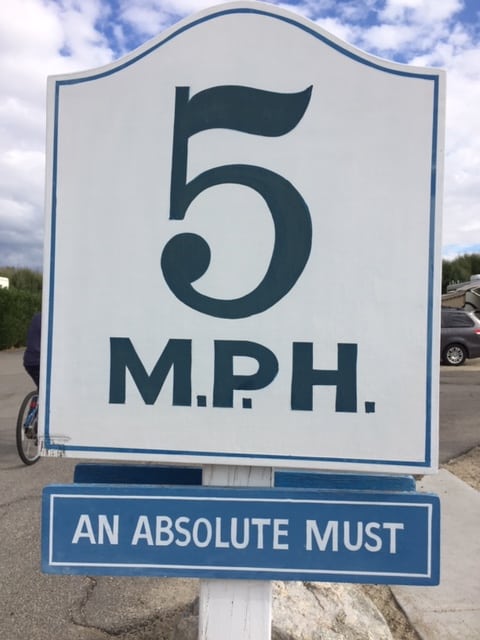
- Drive Slow. Inside the campground, just like a residential street, you never know when a kid might dart out into the road, a mower might cross your path or a RV might back up without seeing you. Just like in a residential neighborhood, it can be easy to dismiss the posted speed limit and “drive slow” signage but better to be safe. Besides, you never know when it might be your kid darting into the road or your RV backing up.
- No RV Maintenance or Washing at the Site. I imagine the reason for no RV maintenance is two-fold. First, they don’t want to create the appearance of a trashy campground and, often, maintenance can be a multiple day or week project with pieces and parts strewn about. Second, maintenance often means oil, grease and other things end up on the ground and that wouldn’t be great for the RVers who come behind you. As for washing, I think that is more about water consumption and creating puddles. That said, I’ve never gotten in trouble for filling a bucket with water to wipe away road dust from my rig.
- Don’t leave pets tied up outside unattended.
If You Use the Campground’s Wi-Fi, Don’t Stream
Let me start this, not with the etiquette advice, but with some different advice. If you are a regular RV traveler and need or like reliable Wi-Fi for work, staying connected to family or for entertainment, do not count on the “free Wi-Fi” advertised by most campgrounds. You will be sorely disappointed and continually frustrated.
So, my advice if you fall into those categories of internet users is to come up with your own solution such as a hot spot.
However, if you just want it for occasional use such as checking email or scanning and posting to your social media, the Wi-Fi at the campground might be a perfect no-cost solution for you. The campground etiquette here is to remember that you aren’t the only one using the signal. You are sharing it with many others in the campground. As such, you should never stream movies or music. Those take up too much bandwidth and you’ll limit other’s ability to use the internet.
Even if the campground offers Wi-Fi for an additional fee, the situation is usually the same. A lot of users. And that means, no streaming. Just because the campground charges a fee doesn’t mean the quality of the bandwidth is any better.
Pet Related Campground Etiquette
Okay, on the officially rules it says you can’t leave a pet outside unattended. But the rules that aren’t printed and is both good campground etiquette and good pet-owner manners is you should always have your pets on a leash and always pick up after them.
For the campgrounds that have a dog run or a dog park, you’ll find those enclosed. This means you can let your pup run off-leash there. However, even within the dog park, be sure to pick up after them.

Leave No Trace
The principle of Leave No Trace comes from the backpacking community. Or at least that’s the context I always heard the phrase. Interested, I did a little research.
In the post-World War II boom, people started making more use of public lands including National Parks and Forests as well as BLM land. By the 1960s and 1970s, the principals started to emerge as a way to let visitors know what was expected. The basic idea is to be able to go into wilderness areas without harming vegetation, animals, etc. and to leave it pristine for the next person.
There are seven principles. I’m not going to record them here but with a quick internet search, you’ll have no trouble finding them.
The principles are in the name. Leave No Trace. Essentially, if you have been somewhere and another person comes to the same spot behind you, there should be no evidence you were ever there.
Even though a campground is a far cry from backcountry wilderness, the principles still apply. Or better yet, leave your site just a little better than you found it.
Ask Before Receiving Mail or Packages
If you need a package delivered (and who doesn’t need an occasional Amazon box?), most campgrounds allow a package to be dropped off in their office for you.
Rules on the topic of receiving mail vary widely. However, in my experience, even the campgrounds whose list of rules includes one that says you cannot have anything delivered to the campground, allow it. They don’t want all your mail forwarded to them (because they are then dealing with it long after you are gone) but they don’t mind a package or two. That said, here is the campground etiquette advice: always ask before you put down the campground’s address.
I was reading reviews of an Arizona campground. One person wrote that they were kicked out after having a package delivered as that was a violation of the campground’s rules. Now, that seems a little extreme of the campground. But, on the other hand, the campers just assumed they could get away with it even though it was against the rules.
So, always ask. And, if the answer is no, respect that. There are enough other options that it is not worth being asked to leave. Wondering about those options? Use general delivery to the post office. Or, if it’s an Amazon package, use an Amazon locker.
Please add to the list if you think I missed any campground etiquette by commenting below.
Links to Relevant Posts:
- Tips for Making RV Park Reservations
- Fredericksburg in Texas Hill Country
- Adventures in Fredericksburg
- Adventures in Fredericksburg: Country Schoolhouses and the Story of One Outhouse
To see products recently purchased by readers or to browse and shop at Amazon, follow either of these links. Huge thanks for your support.
- Blackstone Tabletop Propane Fueled Outdoor Grill
- i COVER Carry Bag Heavy Duty Water Proof Carry Bag for Griddle Top
- New Star Foodservice Wood Handle Slant Edge Grill Scraper
- Yvan Telescoping Ladder,12.5 Feet
- DuPont Teflon Non-Stick Dry-Film Lubricant Aerosol Spray
Affiliate Link Disclosure. As a result of being an Amazon Affiliate, I earn from qualifying purchases.


I agree with you that walking on my RV space is for me the same as trespassing. Especially with people who come up to the Oliver travel trailer wanting to see it inside and I’m in it taking a nap for example. It’s like having somebody knocking on your door to see the inside of my house. If I’m outside, from the street, ask. I’m probably going to say yes. But then I always have to have the rig cleaned up.
So true, Miguel. I know a couple who travel in a vintage bus who had the same problem. They finally ended up putting a note on the door to say that there were working (which is true) and can’t be disturbed. While this worked pretty well for them, it was surprising to hear that some people completely ignore the note.