
Before I share what I learned about the underground tunnels in Portland and other gritty details of the early days, I must share how I got myself to Portland on the day of the tour.
I’m quite impressed with myself.
Portland’s Public Transportation
I arrived at the previous two Portland tours—the food truck tour and the Hop-On Hop-Off trolley—via car. My friend who accompanied me on the tours drove us from our RV park to downtown Portland where we used a parking garage.
The parking garages had low clearances and tight spaces. Since I was heading to this last tour solo, I was hesitant to drive my van. It’s taller than a car which left me with doubts whether it would clear a parking garage. Plus, with the longer wheelbase, I knew the back end would stick out, risking someone clipping it. One of my on-the-road fears.
Further, street parking wasn’t an option because the metered parking I saw during my previous two trips to town was limited to a couple of hours.
TriMet
During the food truck tour, Angie mentioned Portland’s public transportation system, TriMet. The “tri” is for the three modes of transport: bus, light rail and commuter rail. She said it was easy, safe and, best of all, many of the stops outside of central Portland were “park and ride” which meant free parking.
I spent the night before the tour on the internet learning about TriMet. I was nervous, as I always am when I do something for the first time. But determined.
After careful study, I decided it was best to drive to a “park and ride” farther east even though Portland was west. I considered the one Angie uses but she said the parking area fills by 7 a.m. and I didn’t need to leave until 9 a.m.
I found plenty of parking at the station I chose and the tracks crossed one end of the lot. A round-trip ticket cost $5. I paid for a round-trip ticket and waited for the train.
So easy.
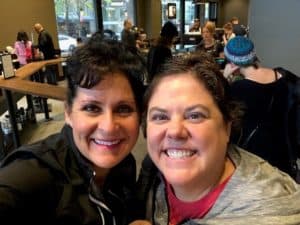
Forty-five minutes after the train arrived at the station, I hopped off at the same downtown square where the other adventures started. I walked a couple blocks to a hotel because the timing was such that my sister was in Portland on a 20-hour layover from her job as a flight attendant. So, it turned out, I did have an adventure partner for the day.
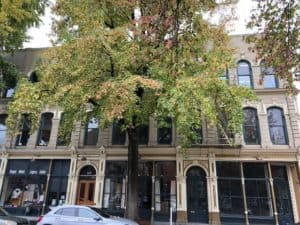
We stopped at a coffee shop then fast-walked to the old Merchant Hotel where the tour about the seedy side of early Portland began and where the other tourists waited for our arrival.
Tour Options
Ironically, I learned about the underground tour from my friend at the RV park. It made her must-do list. Then she decided she didn’t want to go into Portland again. She wasn’t a big fan.
Because she wanted to do the underground tour, I didn’t consider any others. But when she decided not to join me, I started looking at the other tours Portland Walking Tours offers. There are a lot.
Honestly, I wanted to forgo the underground tour for one that made me laugh just reading the description. They offer two ghost hunting tours, called Beyond Bizarre. And to accompany the tour, you get ghost hunting equipment. Ghost hunting equipment! Having never hunted ghosts before, it struck me as tons of good fun. Plus—seriously—ghost hunting equipment?
And if ghost hunting equipment wasn’t enough, one of the tours is for adults only. Basically, the X-rated, really seedy gritty ghost stories. I translate that description as “funny.” Now can you understand why I laughed at just the idea of this tour?
Alas, because of the tour schedule, it didn’t work out for us to go ghost hunting. Both ghost hunting tours are at night and my sister needed to get to sleep early for her 3 a.m. wake up. Plus, I would’ve been a tiny bit scared using public transportation that late at night.
So, I circled back around to where I started. The Underground Portland Tour.
Underground Portland Tour
Despite the name, 95% of this tour is above ground. At first disappointed, I got over it pretty quickly because the tour was so interesting and informative and about the gritty times in Portland.
Also, because it was true.
True? Yep. I know it seems obvious that if a person dons the tour guide hat tourists should be able to expect an accurate portrayal of the topic. The myth of the Shanghai tunnels runs so deep in Portland that businesses see dollar signs and perpetuate the myth. One bar, for example, offers to patrons the chance to enjoy their adult beverage in a Shanghai tunnel. But the truth is, patrons are unknowingly just sitting in a dark basement.
And who would know the difference between a closed portion of tunnel and a basement? Not too many.
There is also a second tour company in Portland offering the Shanghai tunnel tours. Just like the bar, his stories perpetuate the myth of men getting Shanghai-ed. And most of the places the tour visits are, in actuality, basements.
Portland Underground Tour Highlights
A Seamstress
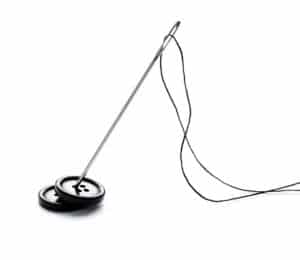
Prostitution has always been illegal in Oregon. So, in the early days, a man looking for company found himself in need of a “seamstress.” The conversation with, say, a barkeep went something like this, “I have a button that’s loose. Do you know where I might find a seamstress to sew it back on?” He’d point to a button on his jacket or the sleeve of his shirt for effect.
A Saloon
The Erickson salon took up a city block in the late 1800s. People came from all over to visit. It was a destination drinking establishment. There were entrances on every side of the building and nearly 700 feet of bar. I read an article that said Erickson employed 60 bartenders with a minimum of 30 working at all times. The building still stands and serves other purposes today. Prohibition ended its glory days.

Japantown
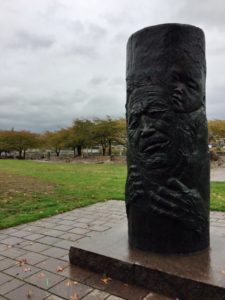
Japantown or Nihonmachi was an area of town that existed before World War II. It’s in the Old Town / Chinatown area of today’s Portland. Over a 3-day period in May 1942, three months after President Roosevelt signed Executive Order 9066 to confine those of Japanese heritage, the area essentially became a ghost town. Some 5,000 Portlanders were interned.
Today you can visit the Oregon Nikkei Legacy Center with the Japanese American History Museum. It was on my list but I never made it so was happy to walk through the Japanese American Historical Plaza on the tour instead. Along the water front, it’s a great place for a stroll. Or Thai Chi which we saw a group practicing.
Though I believe the information on the tour about the Shanghai tunnels, I did find one fact that I couldn’t verify. As we learned about Nihonmachi, the tour guide said the most famous interred Portlander was 10-year-old George Takei who would go on to play Sulu on the television show Star Trek. I’m not sure why I decided to verify this fact, but I did. It turns out not to be true. First, Takei was born in 1937, making him five when he was interned. Second, both Wikipedia and Takei’s own website say he was born and lived in Los Angeles before the war broke out. No mention of Portland.
Getting Crimped
A crimper is a sailor thief. If you were to be crimped, you would be kidnapped through deception or trickery or violence and sold to a boat looking in need of a crew. A crimper made a living, a very good living, because he was paid for each person he crimped. The blood money fee, as it was called, was about $50 per person, or $1,400 in today’s dollars.
Shanghaied means the same thing. Crimping is the older word and no one is entirely sure how or why the word Shanghaied overtook crimped. Some think the names came from the early days of crimping because, in the US, many of the boats headed to China.
Shanghai Tunnels
The myth of Shanghai Tunnels (particularly in Portland and San Francisco) goes something like this: a man goes to a bar, sits on a bar stool and drinks, at some point a trapdoor opens and he falls to a secret underground tunnel. He’s been crimped. The crimper drags him to the boat, forges the man’s signature on the contract, collects his fee and goes in search of his next victim.

The tour guide said all that intrigue simply wasn’t necessary because you could do all of that without the trapdoor and tunnels.
In a nutshell: get a guy stupid drunk.
A common, maybe even sleazier, way to be crimped was for the crimper to approach a man who obviously had no money, probably just came to town, offer to pay for a night in a hotel and to give him a few bucks. In exchange, all he has to do is sign this little contract. Money made most eager to sign.
Once the money was gone, tough guys would collect the sucker and drag him off to the ship, his new home and workplace for the next several years.
So Why the Portland Tunnels?
Even though the tunnels were not used for crimping, they did exist. If not for crimping, then what? Some say they built tunnels to move illegal liquor during Prohibition. But the tunnels existed long before Prohibition though it’s likely the tunnels were used for that purpose during that period.
The answer isn’t nearly as romantic or filled with intrigue to spark the imagination because it’s an entirely practical answer. It was a way to move merchandise from the ships to the basements of stores.
Plus every 60 years, the Columbia River flooded and the tunnels helped the waters drain faster. It’s also said that the tunnels served as an escape route during police raids to uncover illegal activities like gambling and drugging occurred.
The Real Tunnels

Wondering about the 5% of the tour where we saw the tunnels? We saw small portions of the real tunnels in two places on the tour. First, we went into a public building where it’s displayed. The floor opened, maybe a two foot by three foot opening, and glass covered it. Light allows you to look down into the tunnel. It’s interesting but so small and didn’t really do much for me.
As a result, I got so much more from the tour guides stories than I did from this display.
The last stop on our tour was actually where we started, the old Merchant Hotel. We grabbed a flashlight and headed down narrow cement stairs. Yep, to the basement.
But, we did see a real tunnel, off the basement. But only a foot or two into the tunnel because it was sealed off (or maybe it collapsed because there was a big pile of bricks). Except for our flashlights, it was completely dark. So, no photo of it.
More Portland Early Day Stories
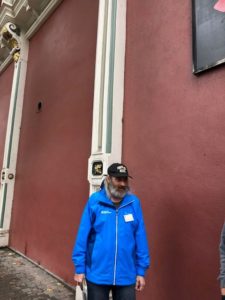
Still in the dark, we sat on benches around the edge of the basement and heard a couple more stories. Did I mention the tour guide was also an actor? It made him a great storyteller, voices and all.
The story that sticks with me is about one of the more well-known successful Portland crimpers, Joe “Bunko” Kelly.
A bunco artist—I had to look this up—is someone who cheats or swindles. No idea why he spelled his nickname with a “k.” However, I do know why he got the nickname. He stole, then sold, a cigar store Indian (you know, one of those wooden life-size ones) to a boat captain. He collected his fee and told the captain the guy was pretty drunk so it would be some time before he woke up.
An interesting side note: Bunko wrote a book titled 13 Years in the Oregon Penitentiary. No, he didn’t go to prison for crimping, despite a 15-year crimping career, crimping a couple thousand men (according to himself). He murdered a man in 1895. Then went to jail for that.
Next Time I Visit Portland
After we came back up the stairs, the tour was over. The tour was fun, interesting and well-worth $23. But I have to say, next time I’m in Portland, you just know I’m going ghost hunting.
Have you ever ghost hunted or been on a gritty-side of a city tour? I’d love to do more tours like this one. And I’d love to hear about your experiences.
Links to Referenced SSL Blog Posts Above:
To see products recently purchased by readers or to browse and shop at Amazon, follow these links. Huge thanks for your support.
- Camco TastePURE Water Filter with Flexible Hose
- 20 foot RV Sewer Hose Support
- Camco 90 Degrees Hose Elbow
As an Amazon Affiliate, I earn from qualifying purchases. Huge thanks for your support.


Looks like an interesting adventure! Oregon is on our list to visit, you’ve made me want to go sooner rather than later. ????
That’s awesome. It was a neat town with lots of adventures for the tourists (and the locals).
I use to work in a NY State Hospital which was made up of many buildings. Most of the buildings were connected by tunnels. I remember walking through the tunnels to get to other buildings. They were pretty well lit but we did have to watch out for bats. Be well. Love, Marie
Yikes, bats. I bet with the crazy cold weather right now, those who still work there are happy for the tunnels.
Debbie,
As always an interesting read. I love Portland! Where do you go next? I think you told me but I forgot….
Sharon
I was in Portland during the month of October. I’m usually 8 – 12 weeks behind on the blog from where I actually am. I like to take my time writing the posts so I don’t forget an interesting tidbit. After I left Portland, I hopped over the Columbia River into Washington and stayed in Long Beach, Washington for the month of November before heading back to Oregon for my lighthouse workamping assignment during December. Over the next weeks, you’ll be reading about those places and experiences. Thanks for the comment.